Moving a vehicle across Nebraska? Secure a route-specific quote and dependable carrier coordination for your dates, destination, and transport needs.
Real, live reviews pulled directly from our Google Business Profile.
Loading reviews…
Call +1 (888) 719-5659 or use our instant online quote form — most routes are dispatched within 24–48 hours.
Get an Instant QuoteNebraska’s main east-west movement follows the Platte River corridor, while northern and southern destinations can sit well away from that line. A shipment to Omaha, Lincoln, Grand Island, Kearney, North Platte, or a rural county address calls for different mileage and access planning. Provide full street addresses and ZIP codes at both ends. For a farm, dealership outside town, or worksite, include the nearest community and the final road rather than relying on a county name alone.
Tell the coordinator where the vehicle will be staged, who can release it, and whether the place has a firm surface and enough room for a long trailer to turn. A broad state label hides the real last mile. If the carrier cannot safely reach the driveway, agree on a legal meeting site and ensure the receiver can get there before a truck is dispatched.
Interstate 80 connects Omaha and Lincoln with Kearney, North Platte, and communities farther west, making it a useful reference for many cross-state moves. It is not a substitute for the origin and destination addresses. A property several miles from an interchange may add meaningful driving time, and access along a gravel road can change whether a loaded carrier can reach the gate. Include the town, ZIP, street or route number, and the best approach from a public highway.
For destinations north or south of the Platte corridor, say so at quote time. A route toward Norfolk, Columbus, Hastings, or the Kansas border cannot be priced accurately from an I-80 exit alone. If the car is going out of state, provide the destination city and state explicitly and flag any required appointment or timing restriction.
The distance between communities grows across the western part of Nebraska. A delivery to Scottsbluff, Alliance, Sidney, or a ranch property near the Panhandle may require coordination beyond the route a carrier already travels. Share the exact location, the nearest town, and a contact who knows the final approach. State whether a long trailer can enter, turn, and leave safely. If not, choose a suitable paved-area meeting point with permission and enough room to inspect and load the vehicle.
Do not assume a carrier can follow an unmarked farm track or cross soft ground simply because a passenger car uses it. Describe gates, seasonal restrictions, road surface, and any local directions. A receiver should be able to meet the driver during the planned window and should know the alternate location in case weather makes the private approach unsuitable.
Grand Island, Kearney, Hastings, and North Platte serve different parts of the state and may involve a mix of residential, commercial, and agricultural pickup sites. An address at a home is not the same as a dealer lot with set release hours or a business yard that requires check-in. Provide the facility entrance, operating schedule, authorization details, lot or stock reference, and a direct number for someone on site. If a local event, sale, or work shift creates a deadline, explain it before choosing dates.
If a vehicle is parked at a residence on a narrow street, ask whether there is space for loading equipment or whether a nearby legal location would be better. Confirm that the neighborhood or property manager allows a commercial carrier to stage there. Clear instructions make rural and small-city pickups less dependent on a driver finding an unfamiliar entrance.
The eastern metro areas have more traffic, construction activity, and local street decisions than a rural pickup west of the Platte. Include the actual neighborhood and property type: a downtown building, subdivision, apartment community, campus, dealership, or industrial yard. Check whether management has a designated loading area, whether a reservation is needed, and whether the carrier can wait at the entrance. A standard car fitting into a garage does not mean the transport trailer can clear its height or turns.
For an Omaha move, a city truck route map and current closure information can help explain local truck access and street restrictions. Follow posted rules and obtain any required permission for staging; do not claim a curb is available without checking. If a permitted alternate lot is needed, provide its exact address and confirm the receiver can meet there.
Nebraska travel can be affected by snow, ice, severe storms, wind, construction, crashes, and reduced visibility. A carrier serving several cities may adjust timing as conditions change. Treat a requested pickup day as a window unless a firm appointment has been confirmed, and keep your phone available throughout that period. If a move is tied to a home closing, job start, or facility release, share the deadline early and ask what timing can be realistically arranged.
Nebraska 511, provided through the Nebraska Department of Transportation, offers real-time road conditions, traffic speeds, work-zone updates, closures, incidents, and camera information. Check it as the shipment approaches, while recognizing that a report can change and a private access road may not be covered. The driver and dispatch make the final safety decision. If a route becomes unsuitable, coordinate a safe alternate time or handoff point.
Tell dispatch if the car starts, rolls, steers, and brakes. Disclose low ground clearance, oversized tires, modifications, mechanical problems, or attached equipment before a carrier is selected. A non-running vehicle may need different loading equipment and should not be described as operable. For an auction, dealership, repair shop, or storage yard, confirm the vehicle is released, the assigned carrier can be admitted, and someone will be present to complete the handoff.
Remove personal property and loose accessories, prepare the keys, and take condition photos before loading. Walk around the car with the driver and retain a copy of the inspection record. At delivery, inspect it again and note concerns before signing. If an agent will meet the carrier, make sure that person has authorization, keys, and order details.
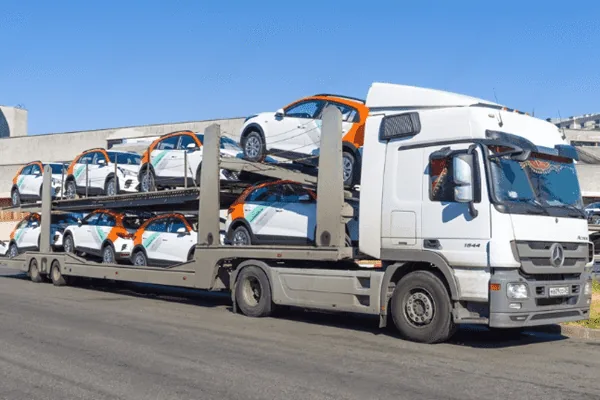
Open transport moves a vehicle on an uncovered trailer and is commonly selected for standard cars. Enclosed transport uses a covered trailer and may be requested for a classic, collectible, luxury, or sensitive vehicle. Availability and cost depend on route, dates, and vehicle details. The equipment also needs usable staging space at both ends. Door-to-door service means the nearest safe, legal place the carrier can reach; it does not guarantee a private driveway, restricted yard, or narrow farm lane.
Provide the vehicle year, make, model, condition, complete addresses, service preference, and date range for a route-specific quote. Include facility hours, access notes, and contact numbers. Ask what the rate covers, how pickup timing is estimated, payment timing, and cancellation terms. If an address changes, contact dispatch promptly so the quote and driver instructions stay aligned.
Omaha and Lincoln sit on the eastern side of a state where many destinations lie far down the I 80 corridor. I 76, I 80 and I 90 help connect longer routes, while county roads may determine the final approach. Tell us whether the vehicle is in the metro or a rural community and name the nearest paved road. Winter conditions and farm access can change the practical handoff.
Learn more about open car shipping, enclosed car shipping and door to door transport, or request a free quote for your route.
Click any state to see local pickup & delivery details, or call +1 (888) 719-5659 for a route-specific quote.
Get an instant, no-obligation quote in minutes — licensed, bonded & insured nationwide.